
When Do You Need Pre-Printed Thermal Labels? A Practical Guide to Pre-Printed Thermal Labels and Thermal Label Printing
When buyers search for Pre-Printed thermal labels, what they usually need to solve is not simply whether a label can be made in color or with graphics. The real questions are more practical: when to use printed labels instead of blank labels, whether the variable information should be printed by direct thermal or thermal transfer, how materials and front-end printing should be matched, and why some labels look fine as samples but later run into alignment, die-cutting, or sensing issues in production.
From our past experience with these projects, the most common pattern is this: buyers first focus on color and size, but the outcome is more heavily affected by a few other points. Those include the later thermal label printing method, which parts should become pre-printed thermal labels, how variable information printing should be arranged afterward, and whether printing, die-cutting, and sensing can stay stable over time.
Table of Contents
ToggleWhen Pre-Printed Thermal Labels Make More Sense Than Blank Thermal Labels?
Pre-Printed Thermal Labels Are More Useful When Fixed and Variable Content Need to Exist Together
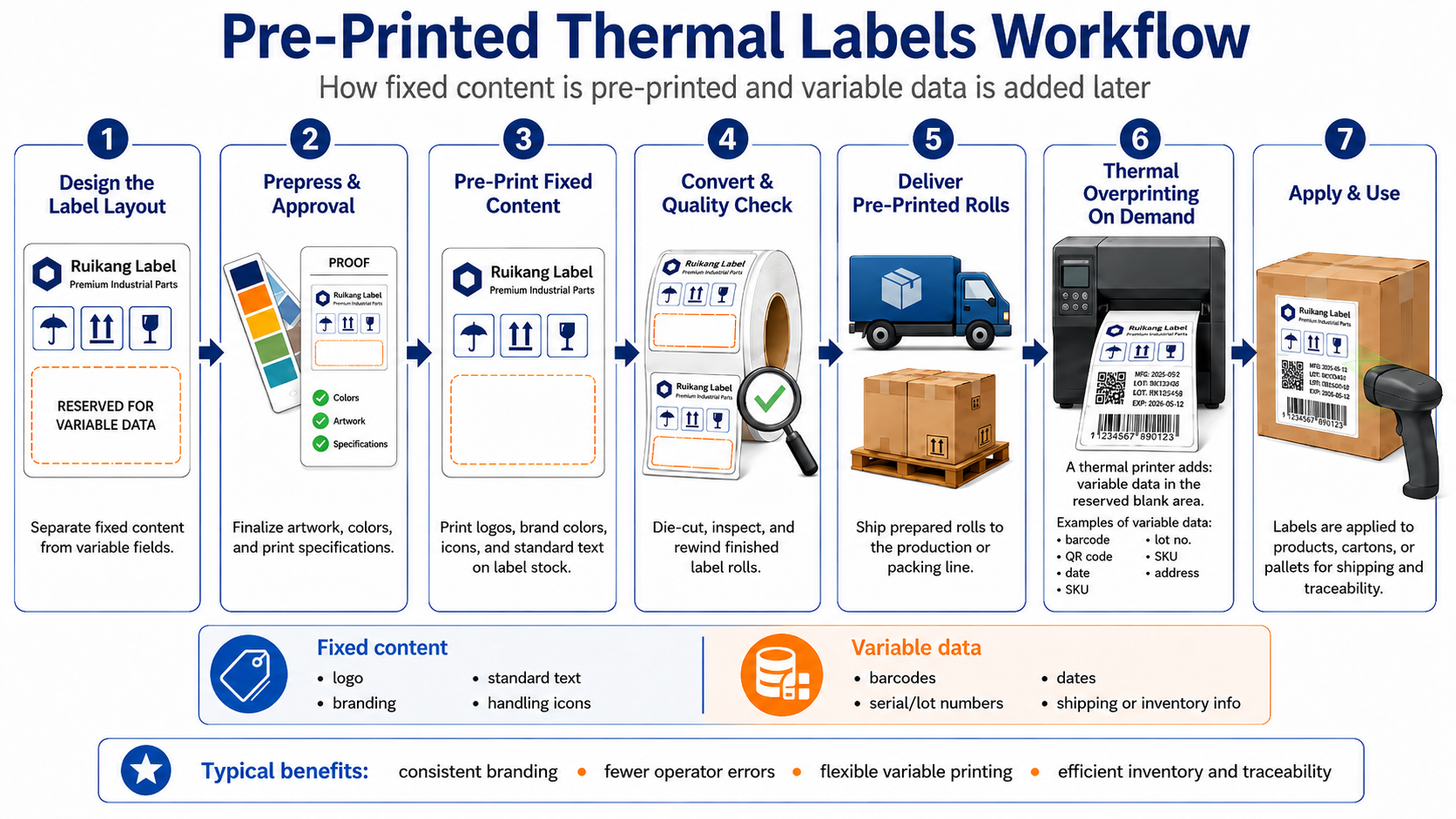
If part of the label content is fixed, such as a logo, color block, warning area, section header, functional zone, or standard layout, while another part needs to change based on order, batch, SKU, date, or address, pre-printed thermal labels are usually a better fit than blank thermal labels.
The value is not that they look more elaborate. The value is that fixed content and variable content are handled separately. Front-end printing takes care of the fixed elements, while later variable information printing handles the barcode, batch number, date, price, or address. This usually makes the layout clearer and the later printing process easier to keep consistent.
Pre-Printed Thermal Labels Matter When Color or graphics Serves a Functional Purpose
Some applications are not suitable for putting everything into one fully fixed printed design. The fixed part can be prepared in advance, while the variable part is left for later printing. That keeps the flexibility of on-demand thermal label printing while making the label easier to read and easier to use in practice.
Key points:
- Fixed content and variable content need to exist together
- Color is being used for identification or workflow management
- Later variable printing still needs to remain flexible
What Materials and Printing Methods Are Commonly Used for Pre-Printed Thermal Labels
Start With the Later Printing Method: Direct Thermal and Thermal Transfer Solve Different Problems
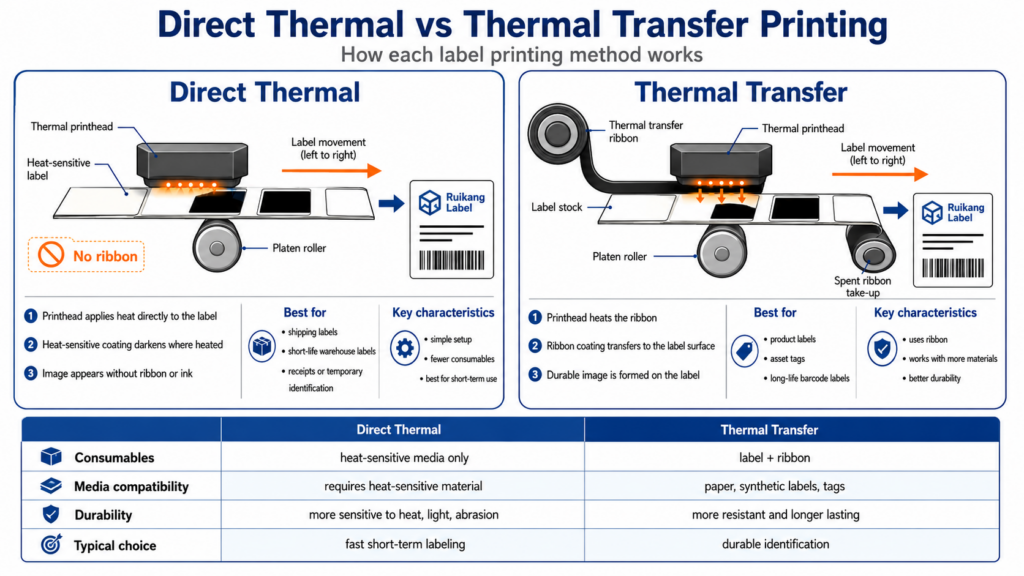
In thermal label printing, direct thermal and thermal transfer should be separated from the beginning. Zebra’s official knowledge page explains the difference clearly: direct thermal relies on heat-sensitive material that graphics directly under the printhead and does not require ribbon, while thermal transfer uses a heated ribbon to transfer the graphics onto the label surface. Zebra also notes that direct thermal labels are more vulnerable to heat, light, and abrasion and are more common in shorter-life applications such as shipping labels and receipts, while thermal transfer is better suited to labels that need longer readability and better durability.
That means the word “thermal” in pre-printed thermal labels does not describe how the color is created. It describes how the variable information is added later. Whether the label is pre-printed is one layer of the decision. Whether the later printing is direct thermal or thermal transfer is another.
Then Look at the Material: Paper and Synthetic Materials Solve Environmental Requirements
Material selection is usually best approached from the actual use environment. For short-life, indoor, cost-sensitive applications, paper materials are often enough. If the label will face frequent rubbing, moisture, or longer service life requirements, synthetic materials are often a safer choice.
This part is easy to underestimate. In the sample stage, what stands out most is usually the color and layout. Once the label goes into real use, the important issues shift to adhesion, abrasion, feeding, scanning, and storage. The later variable information printing may be stable, but if the material is wrong, the overall result can still fail.
How the Front-End Printing Method Is Usually Matched
For the fixed content, the printing method is typically chosen based on order volume, layout complexity, and color requirements. In simple terms, repeatable higher-volume jobs with clearer structures are more likely to use regular production printing methods, while smaller quantities, frequent revisions, or trial-stage jobs may require a more flexible approach.
For buyers, the more important issue is not memorizing every process name. It is confirming two things: how the fixed content will be created, and whether that front-end structure will interfere with later thermal label printing. That matters more than simply asking whether the label is “printed in color.”
How to Distinguish Blank Thermal Labels, Pre-Printed Thermal Labels, and Other Thermal Label Types
The most practical way to understand these products is to separate “blank vs. pre-printed” from “direct thermal vs. thermal transfer.” Blank or pre-printed determines whether the fixed content has already been prepared. Direct thermal or thermal transfer determines how the variable content will be printed later.
| Label structure | Fixed content handling | Variable content printing method | Better suited applications |
|---|---|---|---|
| blank thermal labels (blank direct thermal labels) | No pre-print | Direct thermal printing | Standard logistics labels, short-life warehouse labels, temporary identification |
| pre-printed thermal labels (pre-printed direct thermal labels) | Color blocks, logos, headers, or functional zones printed in advance | Direct thermal printing | Retail identification labels, warehouse zone labels, process labels, and labels that use pre-printed color blocks or functional color zones. Some full-color thermal labels can also be produced by pre-printing. |
| blank thermal transfer labels | No pre-print | Thermal transfer printing | Variable-information labels with higher durability requirements |
| pre-printed thermal transfer labels | Fixed layout printed first, variable content printed afterward | Thermal transfer printing | Labels that need both fixed layout and higher durability or broader material compatibility |
The most important point in this table is that pre-printed thermal labels are not a third label type outside direct thermal and thermal transfer. They are simply labels where the fixed content has been added in advance. The variable information still needs to be printed later through either direct thermal or thermal transfer. Zebra’s official guidance is a good reference for the differences in imaging method, durability, and application fit.
If you want more details about the difference between direct thermal labels and thermal transfer labels, please visit “Direct thermal labels and thermal transfer labels“
What Buyers Should Really Check When Ordering Pre-Printed Thermal Labels
Do Not Just Ask Whether Color or graphics Can Be Made — Ask How It Will Be Made
This is one of the easiest parts of the project to oversimplify. A simple color block or logo is not the same as a complex multicolor layout. Buyers should confirm whether the design uses spot colors or process colors, how many colors the machine can run in a single pass, which colors must be printed separately, and which can be built through color combinations.
If the design is already close to or beyond the press’s single-pass color configuration, the discussion is no longer just about whether the appearance can be matched. It becomes a question of registration stability, edge control, and whether later variable print placement can remain accurate. FTA’s FIRST 5.0 design guide explicitly lists color-to-color registration and print-to-cut as control items for multicolor work, and it also stresses that designers should understand production and converting capability rather than leave every challenge to the press stage.
The Pre-Printed Zone and the Variable Information Printing Zone Should Be Separated Early
This matters just as much as color. Barcodes, dates, batch numbers, and addresses need to sit in areas that are suitable for later printing and scanning. If the front-end printed area overlaps with the variable print zone, or if there is not enough safe space reserved for later printing, variable information printing becomes much harder to keep stable.
This issue shows up often in pre-printed thermal labels because buyers naturally notice the color and visual layout first. In real use, the more common problem is that the variable area is crowded out, the print placement becomes unstable, or barcode readability is affected.
Roll Direction, Core Size, Roll Diameter, and Sensing Method Need to Be Confirmed Together
For labels that are actually going onto equipment, these details are not minor. This is especially true for pre-printed thermal labels. If the later equipment depends on gap sensing, black mark sensing, or another logic, and the roll direction, pitch, or sensing setup is not clearly defined early, it becomes very easy for production to reach a point where “the sample looked fine, but the labels do not run well.”
Note:
- The way color is produced should be reviewed together with the machine configuration
- The variable print area should not be crowded out by the pre-printed design
- Roll direction, sensing method, and pitch are best confirmed before sampling
Why Some Pre-Printed Thermal Labels End Up Misaligned, Poorly Cut, or Difficult to Sense Reliably
Because These Labels Involve More Than Printing Alone
A blank label structure is simpler, so many issues remain hidden. Pre-printed thermal labels are different because the fixed layout is already present. Color, artwork position, die-cut position, sensing marks, and the later variable print zone all affect one another.
If any one of those points drifts, the later result may include misalignment, uneven die-cutting, sensing problems, or unstable print placement. FTA emphasizes print-to-cut in FIRST 5.0 for exactly this reason: multicolor production is not only about whether the colors look correct, but also whether the printed graphics and die-cut position can stay in relationship over time.
Complex Layouts Magnify Problems More Than Simple Ones
A few simple color blocks are one level of difficulty. Multicolor alignment, fine text, reverse type, or elements placed close to edges are another. The more complex the layout, the more it depends on registration control, tension control, die-cut relationship, and consistency across continuous production.
At the sample stage, quantities are small and production is slower, so some issues may not show clearly. Once production becomes continuous, even small deviations can become much more visible. Buyers looking only at one or two samples often cannot judge the real production condition.
How to Tell Whether a Supplier Can Produce Pre-Printed Thermal Labels Reliably
First, Look at How Specific Their Questions Are
A supplier that really understands this category usually does not stop at size and quantity. They will continue by asking about the later printing method, the actual use environment, what the variable content is, roll direction, where the variable print zone should go, whether the design uses simple color blocks or complex multicolor artwork, and how the labels will be sensed.
The more specific these questions are, the more likely it is that the supplier understands where the real risks are.
Then Look at Whether They Treat Color, Die-Cutting, and Later Printing as One System
Being able to print is not the same as being able to produce pre-printed thermal labels that will run reliably. What matters more is whether the supplier considers color execution, die-cut relationship, sensing logic, and later thermal label printing together.
This becomes especially important when the label includes pre-printed color and still needs later variable information printing. The real issue is not whether one roll can be printed. The real issue is whether position, sensing, and usability can stay stable over time.
Finally, Look at How They Handle the Gap Between Samples and Production
A more reliable supplier usually does not focus only on sample appearance. They will identify which items should be locked during the sample stage, and which must be confirmed before volume production, such as variable-zone placement, sensing method, die-cut relationship, how complex color is being produced, and whether tolerance safety margins need to be reserved.
The earlier these points are settled, the lower the chance of repeated sample changes, rework, or running problems later.
Closing Thought: The Real Issue With Pre-Printed Thermal Labels Is Not Just the Color and graphics
When buying pre-printed thermal labels, the key question is usually not whether color or graphics can be made. It is how the label will actually be built. That includes whether the later variable content will be printed by direct thermal or thermal transfer, which fixed content should become pre-printed thermal labels, whether the material fits the use environment, how much room is being reserved for variable information printing, whether the design exceeds single-pass color capability, and whether printing, die-cutting, and sensing can stay stable in production.
When those points are defined early, pre-printed thermal labels are often a better fit than blank thermal labels for real operating environments, especially where fixed content, color cues, and later variable printing all need to work together on the same label.
Further Reading
For buyers evaluating blank thermal labels, pre-printed thermal labels, or other custom label structures, the following references may be useful during specification review and supplier communication. Zebra’s official knowledge page explains the practical differences between direct thermal and thermal transfer printing, including common application fit and durability considerations. The FTA FIRST 5.0 Design Guide is a useful reference when reviewing more complex layouts, especially where color registration, print-to-cut accuracy, and production consistency may affect final label performance.
FTA FIRST 5.0 Design Guide:
https://www.flexography.org/wp-content/uploads/2014/11/FFTA-FIRST-5.0-Design-Guide.pdf