
Direct Thermal vs Thermal Transfer Labels: What’s the Difference?
Direct thermal labels print on heat-sensitive material and do not require a ribbon. Thermal transfer labels print through a ribbon and are better suited to labels that need to last longer or hold up better during handling and storage. The right choice depends on how the label will be used, how long it must remain readable, and what conditions it will face.
For buyers, the choice between direct thermal and thermal transfer is not just about printer setup. It affects label life, barcode readability, consumables planning, and the risk of relabeling after products are already in storage or in transit. A label that works well for parcel shipping may not be the right choice for warehouse locations or long-term inventory control.
Both printing methods are widely used across logistics, warehousing, retail, and manufacturing. The difference is simple: direct thermal is best suited to shorter-use labels, while thermal transfer is better for labels that need stronger durability. The key is to match the label to the job.
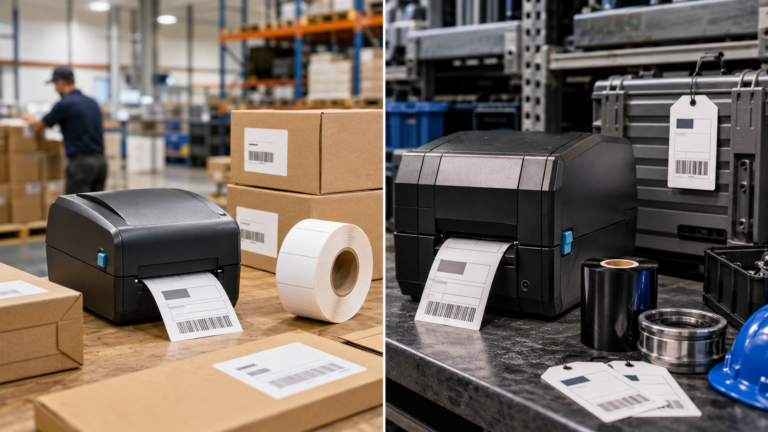
Table of Contents
ToggleWhat Is Direct Thermal Printing?
Direct thermal printing creates an image by applying heat directly to a coated label surface. No ribbon is required. That makes the process simpler, with fewer consumables to manage and less routine handling during printer operation.
Direct thermal labels are commonly used for shipping labels, courier labels, carton labels, and other short-term barcode applications. In these cases, the label only needs to stay readable through picking, packing, shipping, delivery, or brief storage.
This is the main strength of direct thermal: it is straightforward and efficient. It supports fast printing, simple loading, and easier day-to-day operation, especially in high-volume shipping environments.
The limitation is service life. Because the image is created on a heat-sensitive surface, it is less suitable for labels that must remain readable for a long period or go through heavy handling. Exposure to heat, sunlight, rubbing, moisture, or storage over time can reduce print clarity.
What Is Thermal Transfer Printing?
Thermal transfer printing uses a ribbon to transfer ink onto the label surface. This adds one more consumable to the system, but it also creates a more durable printed image.
Thermal transfer labels are widely used for warehouse labels, inventory labels, asset tracking, shelf labels, and industrial barcodes. These labels are expected to stay readable for longer periods and may be scanned many times during storage, movement, and handling.
Compared with direct thermal, thermal transfer is better suited to labels that need stronger resistance to wear and a longer useful life. It is a more practical choice when barcode reliability matters beyond the short shipping cycle.
Ribbon selection can also be adjusted based on the application. Standard paper labels may use wax ribbons, while more demanding applications may use wax-resin or resin ribbons. The main point for buyers is simple: thermal transfer gives more flexibility when label durability is a priority
Direct Thermal vs Thermal Transfer: Main Differences
The technical difference between the two methods is straightforward. Direct thermal prints on the label material itself. Thermal transfer prints through a ribbon onto the label surface. In practice, that leads to different results in durability, consumables handling, and application fit.
Direct Thermal vs Thermal Transfer
| Feature | Direct Thermal | Thermal Transfer |
|---|---|---|
| Ribbon Required | No | Yes |
| Printer Operation | Simpler | Slightly more involved |
| Label Life | Shorter | Longer |
| Resistance to Handling | Lower | Better |
| Best Fit | Shipping and short-term use | Warehouse, inventory, and long-term use |
| Consumables | Labels only | Labels and ribbon |
For most buyers, the real difference is not the print method itself, but how long the label needs to perform without failure. Direct thermal simplifies operation. Thermal transfer provides a stronger margin for longer service life and repeated handling.
Which Is Better for Shipping Labels?
For shipping labels, direct thermal is the more practical choice in most cases. Parcel labels normally only need to stay readable through fulfillment, transport, and delivery. Once the shipment is completed, the label has done its job.
That makes direct thermal a good fit for e-commerce shipping, courier operations, and outbound carton labeling. It keeps printing simple and avoids the need to manage ribbon inventory for short-life labels.
If the label only needs to last through the shipping cycle, thermal transfer may add cost and complexity without adding much value.
Which Is Better for Warehouse and Inventory Labels?
Warehouse and inventory labels are a different case. These labels may remain in use for weeks or months. They may also be scanned repeatedly during putaway, picking, cycle counting, replenishment, and internal movement.
For that reason, thermal transfer is generally the better option for warehouse locations, inventory identification, and labels that stay with products or storage positions over time. Better print stability reduces the chance of relabeling and helps maintain scan accuracy in daily operation.
When labels are touched more, moved more, and expected to last longer, stronger print durability becomes more important than the lowest upfront consumables cost.
Which Is Better for Asset Tracking and Long-Term Barcode Use?
For asset tracking and longer-term barcode applications, thermal transfer is the safer choice. These labels are expected to remain readable beyond short shipping or temporary handling. They may stay on equipment, racks, bins, pallets, or inventory items for extended periods.
If a barcode is used repeatedly over time, label failure creates more than a printing issue. It can slow work, create manual checks, and increase the need for relabeling. In these applications, a more durable print method is worth considering from the start.
Is Direct Thermal Always Cheaper?
At first glance, direct thermal looks cheaper because it does not require a ribbon. That is a real advantage, especially in high-volume shipping operations.
But cost should not be judged by consumables alone. A lower upfront label cost does not always mean a lower operating cost. If labels fade too early, stop scanning, or need to be replaced after goods are already stored or distributed, the total cost goes up through labor, delays, and relabeling.
A better cost question is this: which option keeps the label readable for the full period it is needed? For short-term use, direct thermal may be the more economical choice. For longer-use labels, thermal transfer may offer better overall value.
Quick Selection Guide
A simple way to choose between direct thermal and thermal transfer is to ask four practical questions.
How long does the label need to last?
If the label only needs to remain readable for a short shipping cycle, direct thermal is a strong option. If it needs to stay clear for months or longer, thermal transfer is the better starting point.
How much handling will it go through?
Labels that are scanned once and discarded have different requirements from labels that are touched, moved, and scanned many times. More handling increases the value of a more durable print.
What conditions will the label face?
Heat, sunlight, moisture, friction, and long storage time all make label performance more demanding. The tougher the conditions, the less suitable a basic short-life label becomes.
What happens if the label fails?
If failure only means reprinting a carton label before dispatch, the risk is limited. If failure means relabeling inventory, slowing warehouse work, or losing barcode readability in storage, durability should be a purchasing priority.
How to Choose the Right Option
Direct thermal is the right fit when the label life is short, the environment is manageable, and operational simplicity matters most. Thermal transfer is the better choice when the label must remain readable longer, go through more handling, or support reliable scanning over time.
Many businesses use both. Direct thermal may be used for outbound shipping labels, while thermal transfer is used for warehouse locations, inventory control, and asset identification. The better choice depends on the application, not on a general rule.
Need Help Matching the Label to the Application?
If the decision is not clear, the most useful next step is to review the application itself: how long the label must last, what surface it will be applied to, how it will be handled, and how important barcode readability is over time. A supplier with practical converting and application experience can help narrow the choice without overcomplicating the specification.
If you are new to the topic, see our guide to thermal labels and tags