
Thermal Labels for Warehouse Operations: Applications, Materials, and Buying Guide
Modern warehouse efficiency depends heavily on a stable labeling and barcode system.
From receiving and putaway to inventory control, picking, packing, shipping, and returns, thermal labels are used throughout the warehouse workflow. A clear, durable, and scannable label helps reduce manual errors, improve picking speed, and make inventory management easier to control.
In real purchasing decisions, however, “warehouse labels” should not be treated as one generic product. Different warehouse applications require different label materials, adhesives, sizes, and printing methods.
A shipping label on an e-commerce package may only need to stay readable for a few days. A rack location label on a metal beam may need to be scanned for years. A freezer label may face low temperatures, condensation, and frost. A pallet label may be exposed to forklift handling, stretch wrap friction, and long-distance transportation.
Choosing the right thermal labels for warehouse operations is not just about buying rolls of labels. It is about selecting a reliable identification system for the entire warehouse workflow.
Why Warehouses Use Thermal Labels
Warehouses use thermal labels not only because they are cost-effective, but because they fit high-volume, barcode-driven operations.
In a warehouse environment, labels usually need to print quickly, produce clear barcodes, scan reliably, support consistent batch supply, and work with common barcode printers such as Zebra, Honeywell, TSC, and SATO.
Thermal labels are commonly used for SKU labels, carton labels, rack location labels, pallet labels, inventory barcode labels, and shipping labels. For 3PL warehouses, e-commerce fulfillment centers, retail distribution centers, manufacturing warehouses, and cold chain facilities, thermal labels are one of the most practical labeling options.
Still, not every warehouse application should use the same label. Short-term shipping labels often work well with direct thermal labels, while long-term identification, frequent scanning, heavy friction, or demanding environments usually require thermal transfer labels.
| Warehouse Concern | What the Label Needs to Support |
|---|---|
| Scanning efficiency | Clear barcodes that scanners can read quickly |
| Inventory accuracy | Stable label information that does not peel off or become unreadable |
| Operating speed | Fast printing and efficient labeling |
| Printer compatibility | Correct roll size, core size, ribbon compatibility, and printer fit |
| Environmental resistance | Performance under cold, moisture, friction, dust, or temperature changes |
| Total operating cost | Fewer reprints, relabeling tasks, scanning failures, and manual corrections |
Common Thermal Label Applications in Warehouses
The best way to choose warehouse labels is not to start with the material. Start with the application.
The key questions are: Where will the label be applied? How long does it need to last? How often will it be scanned? Will it face moisture, cold temperatures, dust, friction, cleaning, or temperature changes?
The same warehouse barcode label can perform very differently depending on whether it is applied to a corrugated carton, a metal rack beam, a plastic tote, or frozen food packaging.
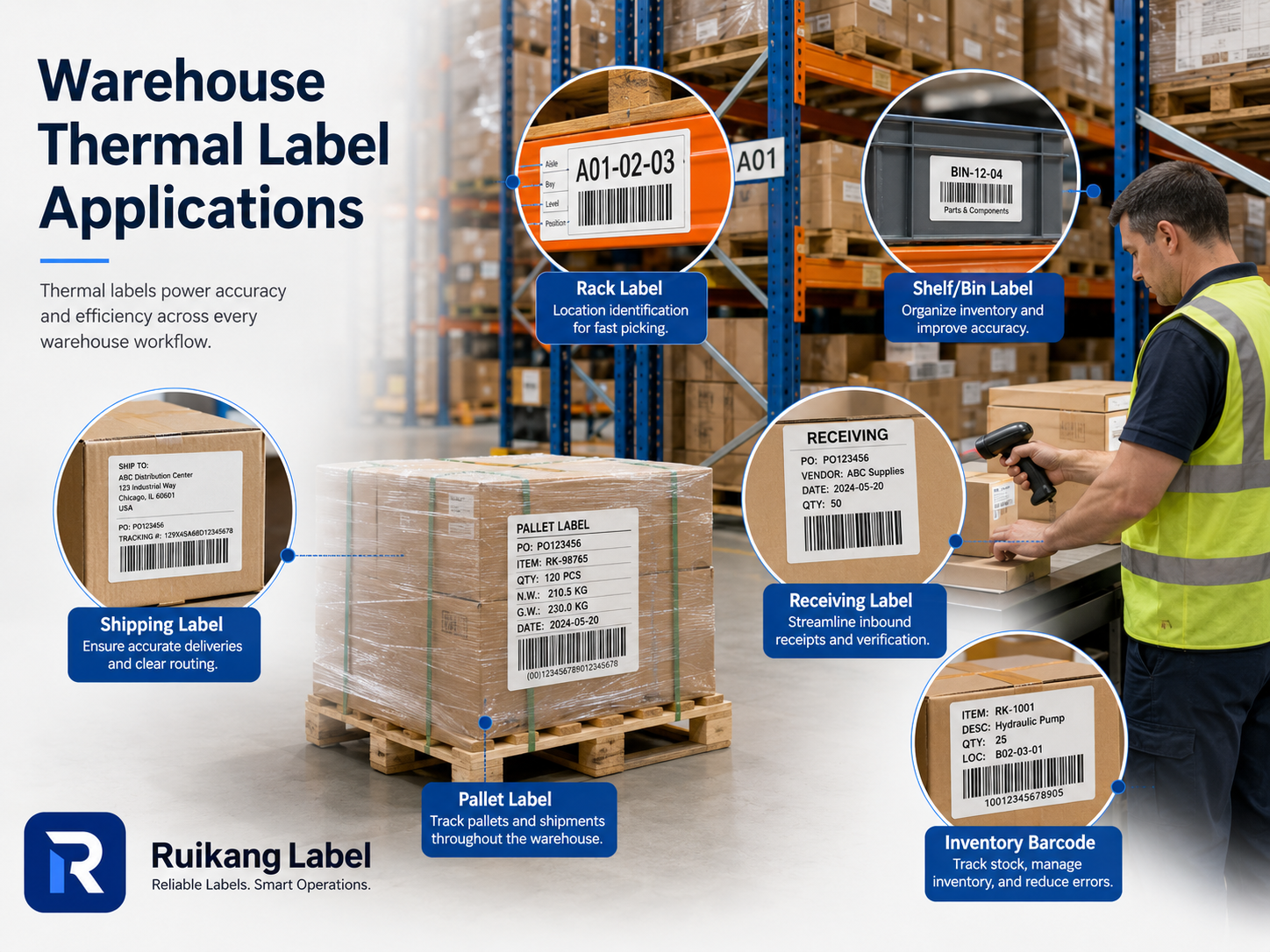
Receiving Labels for Inbound Identification
Receiving is often the first step in a warehouse labeling system.
When goods arrive, warehouse staff may apply receiving labels to cartons, totes, pallets, or individual items. These labels may include SKU numbers, batch numbers, receiving dates, supplier information, internal tracking codes, or quality inspection status.
In many standard receiving workflows, these labels are used for short-term identification, sorting, system entry, and temporary storage. Direct thermal labels are often suitable because they print quickly, require no ribbon, and support high-volume, short-term printing.
However, if receiving labels need to remain on products or cartons for months, the label should not be treated as a short-term shipping label. For example, items may be stored for a long period, moved several times, rubbed by cartons or plastic bins, or transferred from a room-temperature receiving area into a colder storage zone.
In these cases, standard direct thermal labels may fade, darken, curl at the edges, or lose barcode readability. If the label needs to be stored longer, scanned repeatedly, or exposed to repeated handling, thermal transfer labels or more stable direct thermal materials should be considered.
Warehouse Rack and Shelf Labels for Location Management
Warehouse rack labels and warehouse shelf labels are critical for location control.
These labels are usually applied to racks, storage locations, bin locations, pick faces, shelf beams, or metal rack structures. They help warehouse staff quickly identify where products should be stored, picked, or replenished.
Unlike short-term shipping labels, rack and shelf labels need long-term durability. If a location label peels off, becomes scratched, collects dust, or can no longer be scanned, it can directly affect picking efficiency and inventory accuracy.
In real warehouse conditions, rack labels may be scanned repeatedly, rubbed by cartons and totes during putaway and picking, lightly hit by carts or pallets, or wiped during cleaning. Metal racks may also have powder coating, oil residue, dust, or surface texture that affects adhesive performance.
For long-term warehouse rack labels, thermal transfer printing is usually the safer choice. It can be paired with more durable facestock and a stronger adhesive. For metal racks, plastic totes, dusty areas, high-friction locations, or cold storage, the label material and adhesive should be reviewed more carefully.
Warehouse Pallet Labels for Bulk Handling and Tracking
Warehouse pallet labels are used for pallet-level identification and tracking.
These labels often carry larger barcodes, batch information, logistics data, warehouse IDs, or customer order information. Compared with small item labels, pallet labels are usually larger and need to support scanning from a greater distance.
During storage and transportation, pallets may be moved, stacked, wrapped, loaded by forklifts, transported by truck, and stored temporarily in different areas. If the label is too small, the barcode contrast is poor, or the placement is wrong, scanning can become slow or unreliable.
Another common issue is the application surface. Pallet labels may be applied to cartons, stretch wrap, plastic film, outer packaging, wooden pallets, or palletized goods. Each surface has different adhesive requirements. Stretch wrap is smooth and may pull back after stretching, which can cause edges to lift. Wood or rough packaging may require stronger initial tack and better surface contact.
For pallet labels, the most important questions are whether the label is large enough, whether the barcode is clear enough, and whether the adhesive can stay bonded to the target surface.
Shipping Labels for Outbound Orders and Logistics
Shipping labels are one of the most common thermal label applications in warehouses.
These labels are typically applied to parcels, cartons, poly mailers, or shipping boxes. They carry recipient information, shipping barcodes, order numbers, carrier information, and outbound warehouse data.
For many parcel, e-commerce, and 3PL shipping workflows, direct thermal shipping labels are a practical choice. They print fast, require no ribbon, and are suitable for high-volume order fulfillment.
However, direct thermal labels have durability limits. They are more sensitive to heat, sunlight, friction, and certain chemicals. For example, a package may sit briefly in sunlight at a loading dock, causing the label surface to darken. Cartons may rub against other packages on a sorting line, damaging the barcode area. High-temperature trucks, moisture, or long shipping cycles can also reduce label stability.
For short-term domestic shipping, direct thermal labels are usually sufficient. For cross-border shipments, extended storage, outdoor staging, cold chain logistics, or high-value tracking, buyers should consider thermal transfer labels or a higher-grade direct thermal material. For a deeper comparison, see Direct Thermal vs Thermal Transfer Labels: What’s the Difference?
Freezer Labels for Cold and Moisture-Prone Environments
Cold storage creates more demanding label conditions.
Standard warehouse labels may fail in low temperatures. Adhesive can harden, edges may lift, labels may fall off, moisture can affect the surface, and barcodes may become unreliable. In frozen food, pharmaceutical cold chain, fresh food storage, and low-temperature logistics, label performance can directly affect traceability and outbound accuracy.
For freezer labels, two details matter most: storage temperature and application temperature.
If labels are applied at room temperature and then moved into cold storage, the requirement may be easier to meet. But if labels must be applied directly in a cold environment, such as onto frozen packaging, condensation-covered plastic bags, frosted cartons, or chilled totes, standard adhesives may not bond properly.
Cold storage also often involves moisture and condensation. When goods move from a freezer to a loading area, temperature changes can create water vapor on the packaging surface. Frozen food packaging may have light frost. Cold chain containers may also experience moisture changes when doors open and close.
These applications often require freezer-grade adhesive, low-temperature facestock, moisture resistance, and clear application conditions. If the label must be applied in a cold environment, buyers should state that clearly during sourcing.
Inventory Barcode Labels for Long-Term Tracking
Warehouse barcode labels are also used for inventory management, asset tracking, and internal identification.
These labels may be applied to storage cartons, plastic totes, parts bins, equipment, tools, samples, work-in-progress goods, or internal assets. They may not be scanned every day, but when they are needed, the barcode must still be readable.
The challenge is service life. A parts bin in a manufacturing warehouse may be moved, counted, replenished, and scanned repeatedly. Plastic totes may be reused. Internal asset labels may need to remain readable for months or years.
If the label is applied to plastic, metal, coated surfaces, curved surfaces, or reusable containers, both adhesive and facestock become important. Standard paper direct thermal labels may not be suitable for long-term use because they can be affected by friction, heat, light, and cleaning.
For long-term inventory barcode labels, thermal transfer labels are usually more stable, especially when the label must survive frequent scanning, extended storage, or complex surfaces.
Return and Exception Labels for Reverse Logistics
Many warehouses also manage returns, exception items, quality inspection failures, and goods waiting for special handling.
These labels may not be part of the standard outbound process, but they are important for warehouse control. Returned goods may need to be inspected, repaired, restocked, scrapped, or resold. Exception packages may need to be separated. Short shipments, mispicks, damaged goods, and restricted items may require clear status labeling.
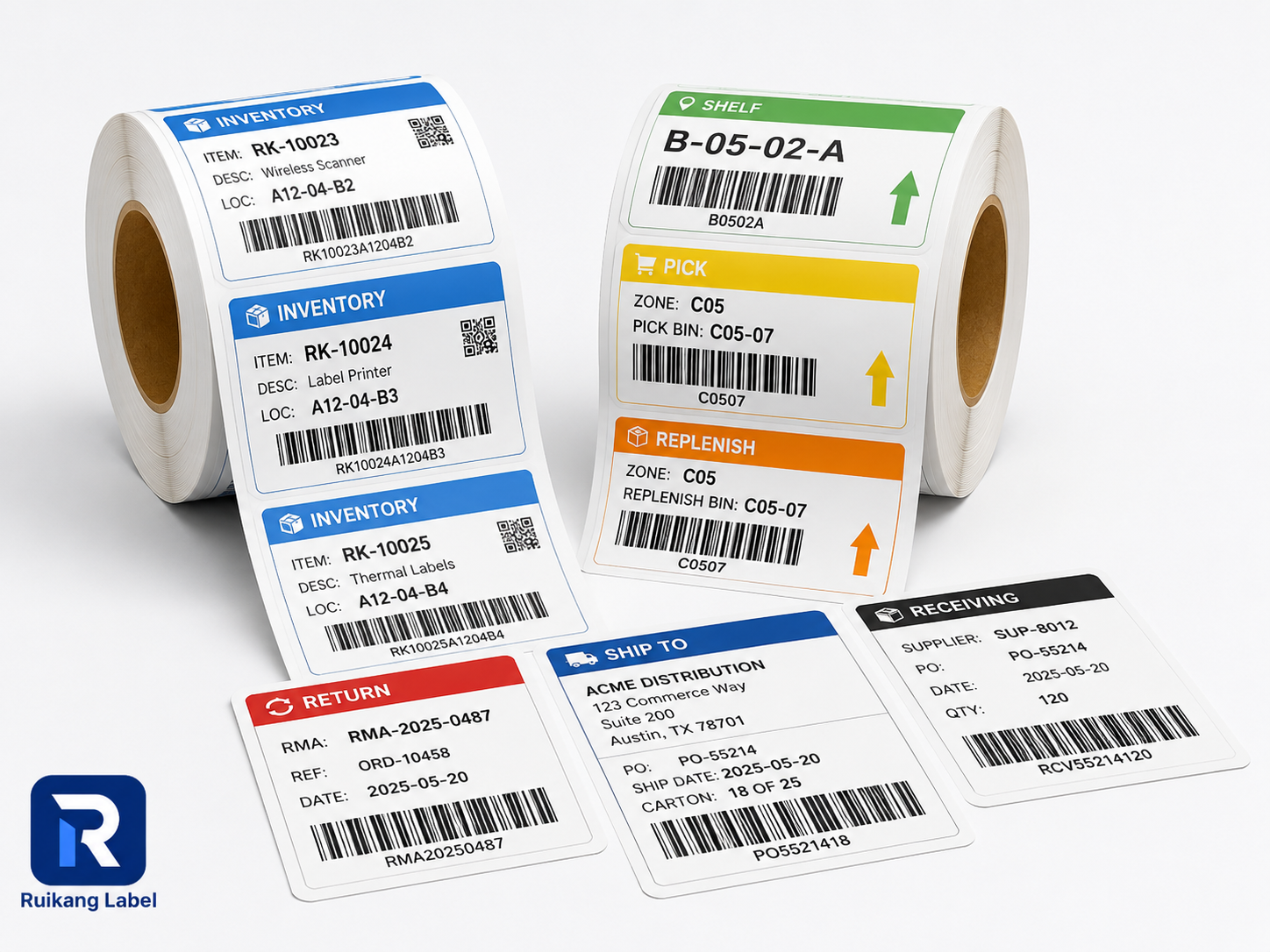
In these workflows, colored thermal labels or pre-printed thermal labels can improve visibility. Different colors can identify different statuses such as pending inspection, return, damaged, priority, hold, or do not ship. Pre-printed instructions can also help warehouse staff understand the required action faster and reduce manual judgment errors.
Matching Warehouse Applications with Label Types
The table below gives buyers a practical starting point. It is not meant to provide one universal answer. Instead, it helps clarify that warehouse labels should be selected based on application, not only on price or size.
| Warehouse Application | Common Use | Recommended Label Type | Key Purchasing Considerations |
|---|---|---|---|
| Receiving labels | Inbound identification, SKU, batch, date | Direct Thermal or Thermal Transfer | Service life, print speed, short-term vs. longer storage |
| Rack labels | Rack location, bin location, storage control | Thermal Transfer is often preferred | Abrasion resistance, long-term barcode readability, adhesive stability |
| Pallet labels | Pallet tracking, bulk handling, warehouse transfer | Direct Thermal or Thermal Transfer | Label size, barcode clarity, distance scanning |
| Shipping labels | Parcel labels, outbound orders, carrier labels | Direct Thermal is common | Print efficiency, printer compatibility, short-term transport |
| Freezer labels | Cold chain, frozen food, fresh food, pharmaceuticals | Freezer-Grade Labels | Low-temperature adhesive, moisture resistance, application temperature |
| Inventory barcode labels | Inventory tracking, asset control | Thermal Transfer is usually more stable | Scan frequency, service life, application surface |
| Return labels | Reverse logistics, exception handling, inspection | Colored or Pre-Printed Labels | Status identification, handling instructions, temporary control |
Direct Thermal vs. Thermal Transfer in Warehouse Use
Direct thermal and thermal transfer are the two most common printing choices for warehouse labels.
Direct thermal labels do not require ribbons. They are simple to use and suitable for short-term labels, shipping labels, temporary receiving labels, and high-volume printing. Their main advantages are speed, convenience, and fewer consumables.
The tradeoff is durability. Direct thermal labels are more sensitive to heat, sunlight, friction, and certain chemicals. If a label may be exposed to hot trucks, outdoor staging, warehouse lighting, repeated handling, forklift movement, or storage for several months, buyers should evaluate the material carefully.
Thermal transfer labels require a ribbon, but the printed image is usually more durable. They are better suited for long-term rack labels, inventory labels, asset labels, freezer labels, and industrial warehouse environments. They generally provide better resistance to abrasion, longer image life, and stronger performance in demanding conditions.
| Decision Question | Better Fit |
|---|---|
| The label is used only for short-term shipping or a few days of transport | Direct Thermal |
| The label must stay readable for long-term storage or repeated scanning | Thermal Transfer |
| The label will be applied to racks, totes, or assets | Thermal Transfer |
| The label is used for high-volume e-commerce order printing | Direct Thermal |
| The label will face friction, moisture, cold, or temperature changes | Thermal Transfer or specialty direct thermal material |
| Label failure could affect inventory accuracy | Thermal Transfer is usually safer |
Choosing the Right Adhesive for Warehouse Labels
Many warehouse label failures are not printing problems. They are adhesive problems.
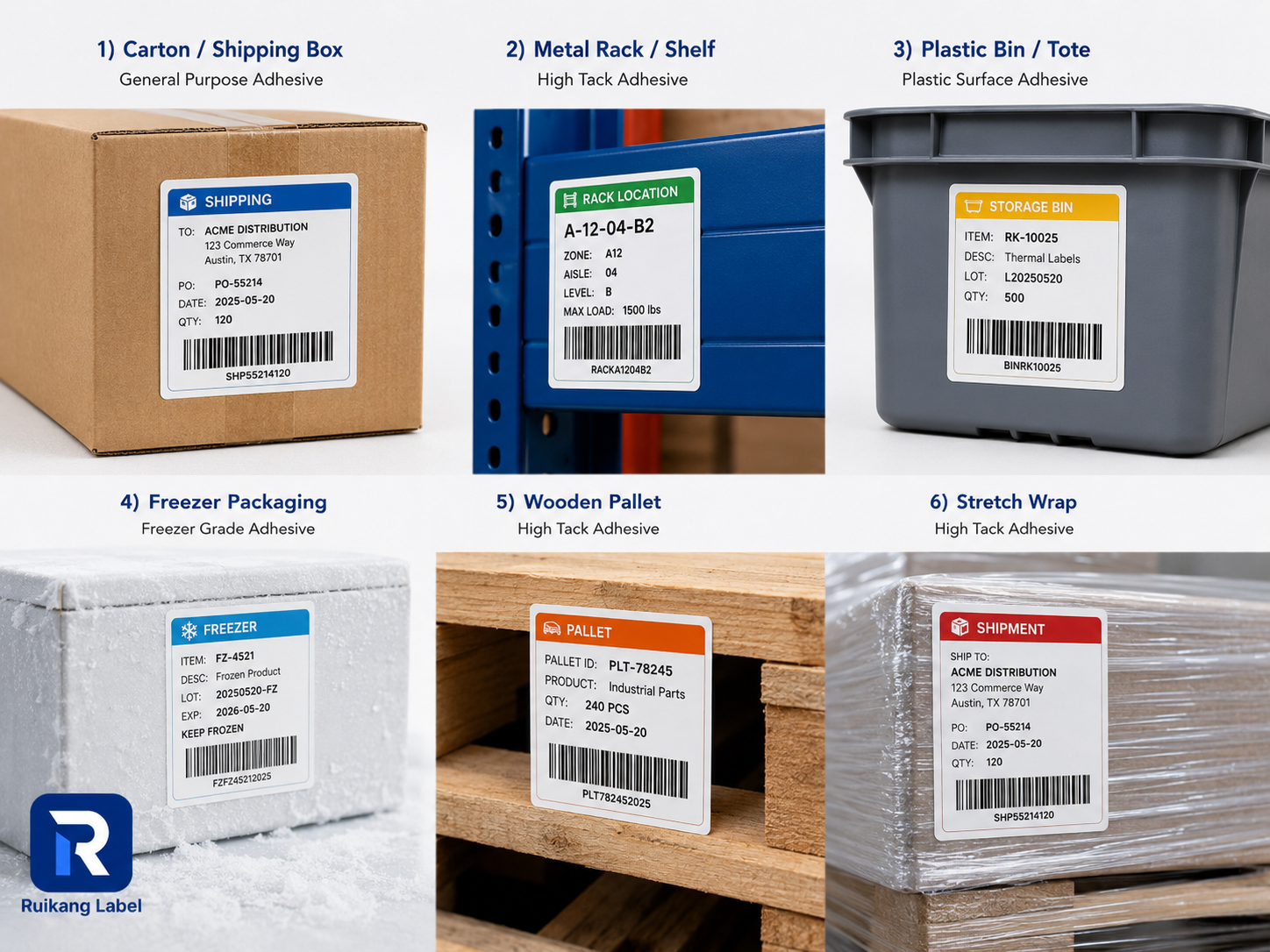
A label may bond well to a standard corrugated carton but perform very differently on plastic totes, metal racks, stretch wrap, freezer packaging, wooden pallets, dusty surfaces, or rough cartons.
Common warehouse label adhesives include permanent adhesive, removable adhesive, freezer adhesive, and high-tack adhesive.
Permanent adhesive is suitable for many cartons, racks, and long-term identification labels. Removable adhesive is useful for temporary labels, reusable plastic totes, or applications where clean removal matters. Freezer adhesive is designed for low-temperature environments. High-tack adhesive is often used for rough surfaces, curved surfaces, low-surface-energy plastics, or difficult substrates.
During procurement, it is not enough to ask whether the label is “sticky.” Buyers should describe the application surface, temperature range, possible condensation, service life, and whether the label needs to be removed later. For a more detailed guide, see Thermal Label Adhesives: A Practical Buyer’s Guide for Custom Labels
| Application Surface or Environment | Common Risk | What Buyers Should Clarify |
|---|---|---|
| Corrugated carton | Rough surface, paper dust affecting adhesion | Carton material, recycled paper content, dust level |
| Metal rack | Coating, oil residue, cleaning friction | Surface condition, long-term use requirements |
| Plastic tote | Low surface energy, weak bonding with standard adhesive | Plastic type, reuse cycle, removal requirement |
| Stretch wrap | Smooth surface, tension and rebound | Whether labels are applied to film, expected transport friction |
| Freezer packaging | Low temperature, condensation, frost | Application temperature, storage temperature, moisture exposure |
| Wooden pallet | Rough and uneven surface | Surface roughness, need for high-tack adhesive |
| Outdoor staging | Sunlight, heat, moisture | Exposure time, temperature range, transport cycle |
Common Warehouse Label Problems and How to Reduce Them
When warehouse labels fail, the problem affects more than the label itself. It can slow scanning, reduce inventory accuracy, interrupt outbound workflow, and increase manual work.
A rack label that falls off can create location errors. A pallet label that fails to scan can delay receiving or shipping. A freezer label that curls can break batch traceability. A shipping label that turns dark may become unreadable during logistics handling.
| Common Problem | Possible Cause | Practical Solution |
|---|---|---|
| Label peeling | Adhesive does not match the surface; cold or moisture reduces bonding | Choose a better adhesive and confirm application surface and temperature |
| Barcode scanning failure | Print density issues, reflective surface, barcode too small | Adjust print settings, optimize label size and facestock |
| Rack label abrasion | Long-term friction, cleaning, forklift or manual contact | Use thermal transfer printing and more durable material |
| Freezer label curling | Standard adhesive fails at low temperature; condensation during application | Use freezer adhesive and confirm application temperature |
| Shipping label darkening | Direct thermal label exposed to heat, sunlight, or friction | Avoid heat exposure or switch to thermal transfer when needed |
| Edge lifting | Curved surface, plastic film, rough surface | Select a better adhesive and suitable label size |
| Label size mismatch | Too much barcode or text information; longer scanning distance | Increase label size and improve barcode layout |
| Printer jams or poor feeding | Roll size, core size, die-cutting, or liner mismatch | Confirm printer model, roll direction, and die-cutting requirements |
In many cases, replacing the printer is not the real solution. The better approach is to review the label material, adhesive, size, liner, roll specification, and printing method together.
What the Wrong Warehouse Label Can Cost
Warehouse labels look like small consumables, but the cost of choosing the wrong label can be much higher than the price of the roll.
In warehouse operations, labels connect physical goods with digital systems. If labels peel off, fail to scan, fade, use the wrong size, or vary from batch to batch, the impact may spread across receiving, putaway, picking, shipping, returns, and inventory counts.
Many label problems do not appear immediately. A label may look fine when first applied, but after several days of transport, weeks of storage, cold exposure, forklift handling, rack friction, or repeated scanning, the problem becomes visible. By that point, the real cost is no longer just the replacement label. It may include relabeling labor, delayed orders, inventory errors, and customer complaints.
Losses from Using the Wrong Label for the Application
One of the most common mistakes is using one type of label in the wrong warehouse environment.
For example, standard direct thermal shipping labels may be used as long-term rack labels. At first, the barcode scans correctly. But after exposure to warehouse lighting, hand contact, carton abrasion, and cleaning, the label may darken, wear down, or lose barcode clarity. Staff may then need to manually enter location codes or replace an entire set of rack labels.
Another example is using standard paper labels in cold storage. The label may bond well at room temperature, but once it enters a low-temperature environment, the adhesive can harden and the edges may lift. When goods move from the freezer to the loading dock, condensation can further weaken adhesion. In food, pharmaceutical, or cold chain logistics, this can affect batch tracking and outbound accuracy.
A third example is applying aggressive permanent labels to reusable plastic totes. The label may stay on firmly, but when the tote needs to be reused, removal becomes difficult and adhesive residue remains. The warehouse then spends extra labor cleaning containers, increasing maintenance costs.
| Wrong Application | Surface-Level Problem | Possible Operational Loss |
|---|---|---|
| Short-term shipping labels used as long-term rack labels | Fading, abrasion, scanning failure | Relabeling, manual location lookup, slower picking |
| Standard labels used in freezer storage | Curling, peeling, moisture damage | Broken traceability, inventory confusion, shipping errors |
| Strong permanent labels used on reusable totes | Residue after removal | Extra cleaning labor, reduced tote reuse efficiency |
| Small labels used for pallet tracking | Poor distance scanning | Slower receiving, shipping, and forklift operations |
| Low-durability labels used for frequent scanning | Worn surface, unclear barcode | Harder cycle counts, more manual entry, higher error rate |
Warehouse label purchasing should not start with “Do you have this size?” It should start with where the label fits in the workflow.
Hidden Costs of Choosing the Lowest Price
Because warehouse labels are recurring consumables, price matters. But focusing only on the lowest unit price can create higher total cost.
Low-cost labels may have unstable facestock, uneven thermal coating, weak initial tack, poor liner quality, inconsistent die-cutting, or loose roll tension. These issues may not always appear in a small sample, but they can affect daily operations during continuous printing and high-volume use.
For example, inconsistent die-cutting may cause poor peeling, printer jams, or print misalignment. Unstable adhesive may cause some labels in the same batch to bond well while others lift after a few days. Uneven thermal coating may produce barcodes with inconsistent darkness, reducing scanner performance.
The expensive part of a cheap label is often the rework that follows.
| Low-Cost Label Issue | On-Site Symptom | Hidden Cost |
|---|---|---|
| Unstable adhesive | Some labels peel or lift at the edges | Relabeling, manual inspection, inventory exceptions |
| Uneven thermal coating | Barcode darkness varies, scanning becomes unstable | Failed scans, manual entry, shipping delays |
| Poor die-cutting | Printer jams, difficult peeling, feeding problems | Printer downtime, wasted material, operator rework |
| Poor liner quality | Roll breaks or feeds poorly | Interrupted batch printing, delayed outbound flow |
| Large batch variation | One batch works, the next creates problems | Higher supply risk, unstable warehouse process |
For a warehouse, labels are not display materials. They are operational consumables that are printed, scanned, handled, and moved every day. A slightly lower roll price does not always mean lower total cost if it increases failure rates and rework.
Operational Risks from Choosing the Wrong Supplier
Warehouse label purchasing also depends on supplier consistency.
Some suppliers can offer low prices but may not maintain stable materials, adhesives, die-cutting, or roll specifications across batches. For basic office labels, this may not be a serious problem. For warehouse labels, batch differences can affect printers, automatic labeling equipment, barcode scanning, and inventory control.
For example, a slight change in roll diameter may cause loading problems. A core size mismatch may prevent the roll from fitting existing printers. Incorrect unwind direction may disrupt automatic labeling. A change in adhesive formulation may cause previously stable rack labels to start lifting.
The larger issue is ongoing supply. Warehouse labels are long-term consumables. If each batch needs to be retested, or if the supplier cannot maintain consistent quality and lead time, procurement teams lose time and warehouse operations become less predictable.
| Supplier Issue | Impact on Warehouse Operations |
|---|---|
| Inconsistent materials across batches | Printing and adhesive performance change from order to order |
| Unstable die-cutting or roll specifications | Printer jams, feeding issues, poor peeling |
| Limited understanding of applications | Wrong material recommended for freezer, rack, pallet, or tote use |
| Price-only quoting | Service life, environment, surface, and scanning needs are ignored |
| Unstable lead time | Label shortages may affect shipping and inventory workflow |
| No sample testing process | Problems are discovered only after bulk purchasing |
A good warehouse label supplier should help reduce trial-and-error, not simply quote the lowest price. This is especially important for warehouse rack labels, warehouse shelf labels, warehouse pallet labels, and warehouse barcode labels, where label failure can affect the entire identification system.
Information to Provide Before Requesting a Quote
For custom warehouse labels, the more clearly buyers describe the application, the easier it is for a supplier to recommend the right material, adhesive, and roll specification.
Before requesting a quote, it is helpful to prepare the following details:
| Purchasing Information | Why It Matters |
|---|---|
| Label size | Determines barcode size, layout, and printer compatibility |
| Roll specification | Includes labels per roll, outer diameter, core size, and unwind direction |
| Printer model | Different printers have limits for roll size, core size, and print width |
| Printing method | Direct Thermal or Thermal Transfer affects material choice |
| Application surface | Carton, plastic, metal, stretch wrap, and freezer packaging require different adhesives |
| Operating environment | Room temperature, cold, moisture, outdoor staging, and friction create different risks |
| Service life | Short-term shipping and long-term rack identification require different materials |
| Pre-printing needs | Logos, color blocks, borders, or fixed text can be printed in advance |
| Colored label needs | Useful for zones, priority levels, stock categories, or status control |
| Barcode type | 1D barcode, QR code, SKU, batch number, and variable data affect layout |
For warehouse purchasing, a better request is not simply “I need warehouse labels.” It is more useful to describe the specific application.
| Vague Request | Clearer Request |
|---|---|
| I need warehouse labels. | We need thermal labels for metal warehouse racks, used for long-term barcode scanning. |
| I need barcode labels. | We need warehouse barcode labels for plastic bins, scanned frequently and used for about 12 months. |
| I need freezer labels. | We need freezer-grade thermal labels for frozen food cartons, applied at low temperature. |
| I need pallet labels. | We need large pallet labels for stretch-wrapped pallets, suitable for warehouse and truck transportation. |
These details directly affect material selection, adhesive choice, core size, printing method, and pricing. For long-term use or demanding environments, sample testing or a small trial order is usually a better path before bulk purchasing.
Do Warehouses Need Pre-Printed or Colored Thermal Labels?
Not every warehouse label needs color or pre-printing. But in many warehouse workflows, pre-printed thermal labels and colored thermal labels can improve visibility and reduce handling errors.
Warehouses may use colors to identify zones, inventory status, priority levels, return handling, special products, or restricted items. Fixed elements such as logos, borders, warning text, zone codes, or handling instructions can be pre-printed by the label manufacturer, while variable barcodes and order data are printed on-site with a thermal printer.
This approach keeps the flexibility of thermal printing while improving visual recognition in daily operations. For more detail, see When Do You Need Pre-Printed Thermal Labels? and When Do You Need Colored Thermal Labels?
| Label Approach | Suitable Warehouse Use |
|---|---|
| Colored zone labels | Different warehouse areas, rack zones, or inventory levels |
| Pre-printed border labels | Shipping labels, inspection labels, return labels, exception labels |
| Pre-printed logo labels | Branded warehouses, retail distribution, customer-specific labels |
| Pre-printed warning text | Fragile goods, cold chain, priority handling, restricted items |
| Colored status labels | Pending inspection, returned, frozen inventory, priority shipment, do not ship |
How to Choose a Warehouse Thermal Label Supplier
For warehouse label purchasing, a supplier should do more than manufacture labels. They should understand how labels are used inside the warehouse workflow.
A suitable warehouse label supplier should recommend materials based on the application, not only quote by size. Shipping labels require print speed and cost control. Rack labels require long-term scanning and abrasion resistance. Freezer labels require low-temperature adhesive. Pallet labels require proper size, contrast, and scanning distance.
Batch consistency is also important. Warehouse labels are recurring consumables. If material, adhesive, die-cutting, or roll specifications vary between batches, the difference can affect printer operation, automatic labeling equipment, and daily scanning efficiency.
For long-term supply, it is better to confirm samples or a small trial order before bulk production. Testing adhesion, print quality, and scanning performance in the real warehouse environment is more reliable than comparing price alone.
| Supplier Capability | Why It Matters |
|---|---|
| Multiple facestock and adhesive options | Warehouse applications vary; one material cannot fit every use |
| Custom roll specifications | Printers and automatic labeling equipment require correct OD, core size, and unwind direction |
| Stable die-cutting | Poor die-cutting can cause printer jams or poor label dispensing |
| Pre-printing and variable printing support | Useful for color coding, logos, borders, and barcode workflows |
| Sample testing | Real warehouse testing is more reliable than paper specifications |
| Long-term supply consistency | Warehouse labels are recurring consumables; batch stability matters |
Conclusion: Warehouse Labels Should Match the Workflow
There is no single best thermal label for every warehouse.
A label that works well for e-commerce shipping may not be suitable for long-term rack identification. An adhesive that performs well on room-temperature cartons may fail on freezer packaging. A direct thermal label that works for short-term transport may not be reliable enough for long-term inventory tracking.
The better approach is to start with the warehouse workflow, then select the material, printing method, adhesive, label size, and roll specification based on the real application.
For procurement teams, choosing the right warehouse thermal labels is not only about reducing label cost. It is about reducing scanning failures, peeling, inventory errors, shipping mistakes, and manual rework.
A roll of labels may not be expensive by itself, but it connects receiving, inventory, picking, shipping, and traceability. A stable labeling solution helps the warehouse run more smoothly and makes inventory and logistics tracking more reliable.