
When Do You Need Colored Thermal Labels?
Many buyers first come across colored thermal labels or color thermal labels and assume the printer itself is producing color. In most standard thermal labeling setups, that is not how it works. Direct thermal labels create the image when heat activates the coating on the label, while thermal transfer printing uses a ribbon to transfer the image onto the material. In both cases, the variable information printed on site is usually black, not full color.
That is why the real value of colored thermal labels is usually not appearance. Their value is faster visual recognition, cleaner workflow separation, and fewer handling mistakes on the floor. For warehouse, logistics, retail, and manufacturing buyers, color is usually a management tool before it is a design choice. If you want a quick foundation first, it helps to start with “What Are Thermal Labels and Tags?”
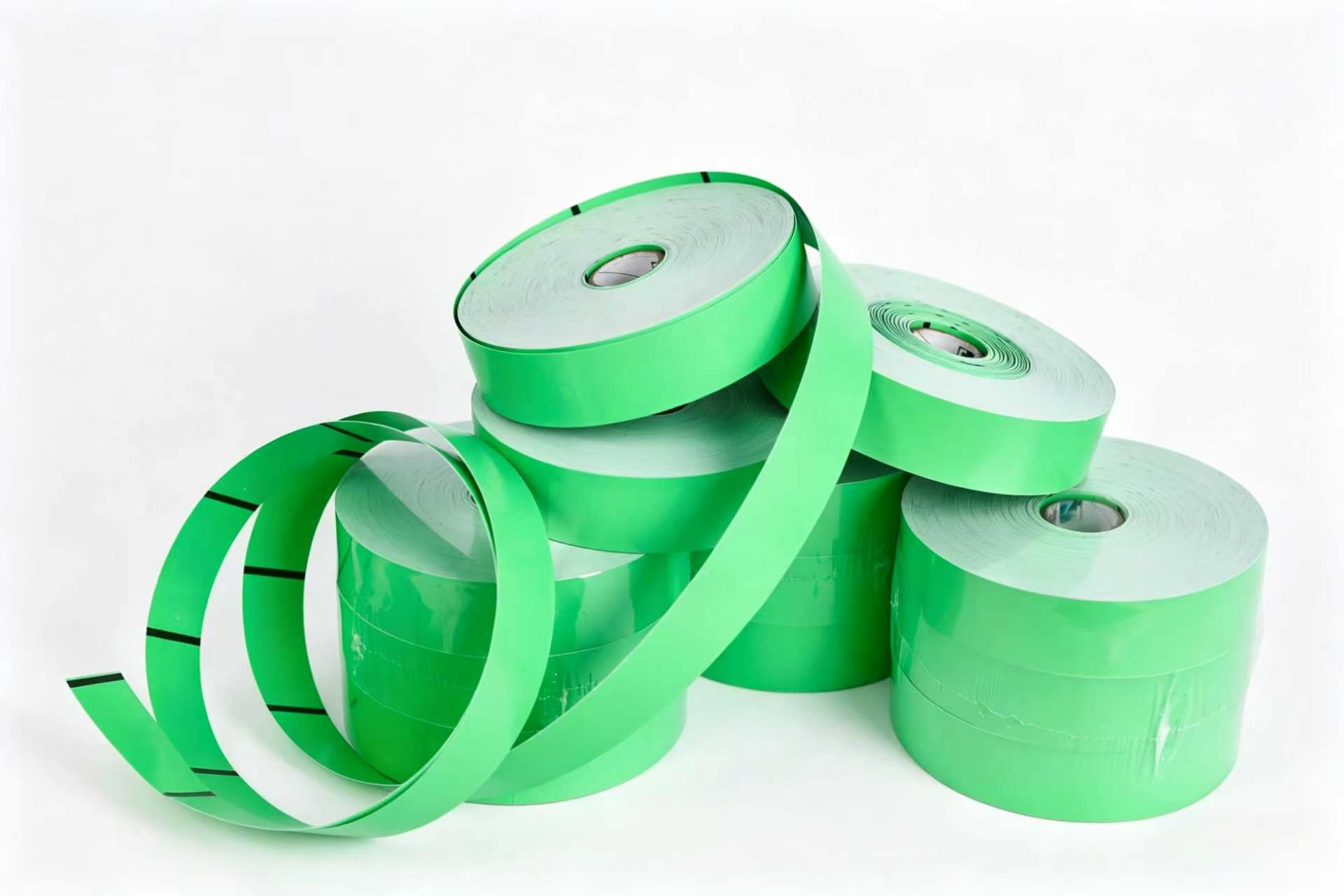
Table of Contents
ToggleWhat Are Colored Thermal Labels?
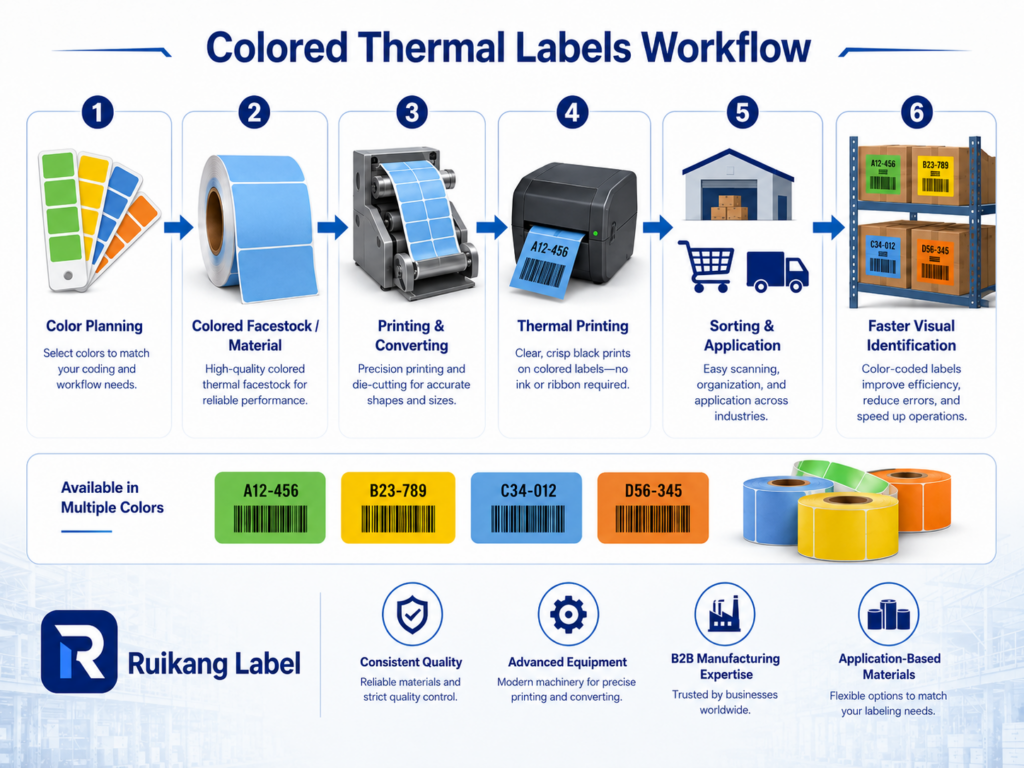
Colored thermal labels usually refer to labels with a pre-colored facestock or a fully colored background made during label production. After that, a thermal printer is used to print black barcodes, dates, batch numbers, SKUs, or shipping information. In other words, the color is already part of the label stock. The printer is only adding the variable data.
They are also different from pre-printed thermal labels. Pre-printed labels are mainly used when fixed content such as logos, headers, warning text, or layout elements needs to be printed in advance. Colored thermal labels are more about using the background color itself for fast identification. If your application includes a lot of fixed content, “When Do You Need Pre-Printed Thermal Labels? ”is the better comparison. If you are still deciding between the two thermal printing methods, “Direct Thermal vs Thermal Transfer Labels” will help you sort out durability, ribbon use, and application fit.
Why Do Businesses Use Colored Thermal Labels?
Companies usually choose color thermal labels because they help people recognize information before they even read the text. A green roll, a yellow roll, and a fluorescent orange roll are easier to separate at a glance than three white rolls, especially in fast-paced picking, packing, replenishment, and sorting environments. That matters when teams are working quickly and handling high volumes.
This is why colored thermal labels make the most sense in operations that depend on status separation, zone separation, route separation, or priority handling. White blank labels are more flexible for general use, but once the workflow has multiple parallel statuses, color often makes daily execution simpler. In many cases, the savings show up in fewer mistakes and faster handling rather than in the label price alone.
Common Applications for Colored Thermal Labels
Warehousing and Logistics
In warehouses and logistics operations, colored thermal labels are often used to separate different order statuses, shipping routes, processing priorities, or storage zones. Returns, rush orders, hold items, and special handling items can all be grouped by color before the barcode or text provides the exact detail. In a high-throughput environment, that first layer of visual sorting can make a real difference.
Retail and Store Operations
Retailers often use colored thermal labels for promotions, markdowns, seasonal categories, and in-store inventory handling. Store teams do not always have time to stop and read every label line by line. A clear color system makes it easier to tell what needs to be moved, repriced, or displayed differently.
Food, Cold Chain, and Manufacturing
In food and cold-chain settings, color is often tied to lot rotation, date coding, or location-based handling. In manufacturing, it is commonly used for QC status, work-in-process tracking, and stage identification. The deciding factor is usually not the industry itself. It is whether the operation benefits from faster visual classification.
How Colored Thermal Labels Compare With White Blank Labels and Pre-Printed Labels
| Label Type | Best For | Content Structure | Common Uses |
|---|---|---|---|
| White blank thermal labels | General printing and low-complexity workflows | Everything printed on demand | Standard shipping labels, basic barcode labels |
| Colored thermal labels | Visual sorting, workflow separation, status recognition | Colored facestock plus black variable data | Warehouse zones, returns, promotions, processing status |
| Pre-printed thermal labels | Standardized fixed content | Pre-printed fixed content plus black variable data | Brand labels, fixed-format labels, warning or compliance layouts |
This distinction matters because the cost structure is different for each option. White blank labels give you the most flexibility. Pre-printed thermal labels work best when the fixed information stays the same for a long time. Colored thermal labels make the most sense when the color rules are stable, the variable content is still simple, and the operation depends on quick visual recognition.
How to Choose the Right Color
Start With Black Print Contrast
The best color is not always the darkest or the boldest. In most thermal applications, the variable information is still printed in black, so the label background needs to leave enough contrast for text, barcodes, and small details to remain readable. That is why lighter backgrounds are usually a safer choice than darker ones.
This is also why light green, light yellow, light blue, and fluorescent shades are often more practical than dark blue, dark red, or deep purple. Once the background gets too dark, black print loses clarity more easily. That becomes more obvious with small fonts, thin lines, and scannable barcodes.
Why Fluorescent Colors Are So Common
Fluorescent green, fluorescent yellow, and fluorescent orange are popular for a reason. They are easy to spot from a distance, easy to separate visually, and they still leave room for strong contrast with black variable printing. In busy warehouse environments, that combination works well.
Some Colors Need More Caution
If the label includes 1D barcodes, QR codes, or smaller text, darker backgrounds should be used more carefully. The more demanding the scan environment is, the more important print contrast becomes. If a label needs to scan quickly and consistently, it is worth testing the exact color and print combination before full production.
When Colored Thermal Labels Help Reduce Cost
Many buyers start by comparing roll price, but the more useful question is total workflow cost. If you already use black-only thermal printers and only need a few fixed colors to identify returns, rush orders, warehouse areas, or process status, colored thermal labels are often more cost-effective than bringing in a separate color printing setup. You keep the current printer base, the team keeps the same process, and the color layer is already built into the stock.
In that kind of environment, the savings usually come from fewer handling errors, fewer mis-sorts, and less rework. There is also less need to create multiple fixed pre-printed layouts just to distinguish categories. As long as the color rules are stable and the color demand is predictable, colored rolls are often the simpler and lower-friction option.
When Colored Thermal Labels Are Not Necessary
If the operation does not really depend on color separation, plain white labels are usually the better buy. For routine shipping information, simple location labels, or basic internal use, color may not create enough workflow benefit to justify the added material and inventory complexity.
Too many colors can also become a problem. If a project only needs two or three colors, colored stock is easy to manage. If it requires many colors across many sizes and adhesive types, the cost starts to show up in purchasing, stocking, changeovers, and dead inventory rather than in the roll price itself.
When a Color Thermal Label Printer Makes More Sense
A lot of search terms such as color thermal label printer, thermal color label printer, or color label thermal printer are really pointing to a different question. The real comparison is often between pre-colored label stock plus black thermal printing and on-demand color label printing.
A color label printer usually makes more sense when there are many SKUs, frequent artwork changes, frequent branding updates, or small production runs with constant switching. In that kind of setup, stocked colored rolls or pre-printed rolls can become expensive because of leftover inventory, obsolete versions, and setup inefficiency. On-demand color printing can reduce that problem because you only print what you need, when you need it.
But if the application is simply “a few fixed background colors plus black variable information,” a color thermal label printer is not always the lower-cost option. Equipment cost, consumables, maintenance, printhead management, and operator training all become part of the equation. If your current workflow already runs well on standard thermal printers, pre-colored thermal label stock may still be the better fit.
A Practical Cost Comparison
| Situation | Better Option | Cost Logic |
|---|---|---|
| A few fixed colors, mostly black variable data | Colored thermal labels | Keeps the current thermal printing setup and avoids new equipment cost |
| A lot of fixed content that rarely changes | Pre-printed thermal labels | Fixed information is built into the label, so only variable data is printed on site |
| Many SKUs, frequent revisions, small batch changes | Color label printer | Reduces obsolete inventory, changeover cost, and short-run waste |
| General internal labels with no real need for color separation | White blank labels | Color does not add enough workflow value to offset the extra cost |
| Longer life and more demanding conditions | Colored thermal transfer labels | Cost decision shifts from color to durability and service life |
How to Choose Between Colored Direct Thermal and Colored Thermal Transfer Labels
If the label is for short-cycle logistics, warehouse movement, shelf marking, or general status identification, colored direct thermal labels are usually the simpler choice. The equipment is common, the process is straightforward, and there is no ribbon involved.
If the label needs better durability, longer life, or stronger resistance to heat, abrasion, or tougher environments, colored thermal transfer labels or colored thermal transfer label stock are usually the better direction. This page does not need to go deep into the technical breakdown because that is already covered in Direct Thermal vs Thermal Transfer Labels.
What Buyers Should Confirm Before Ordering
The most important question is usually not whether a color can be made. It is whether that color will still work well with your printers, scanners, workflows, and application environment. Size, roll diameter, core size, adhesive type, sensing method, and actual black-on-color contrast all affect real-world performance.
If the labels will be used with automatic labeling, batch scanning, or fast sorting, it is usually smarter to test first before locking in the final color and construction. The best question is not “Which color sells best?” It is “What needs to scan, how long does it need to last, and what kind of environment will it be used in?”
Conclusion
Colored thermal labels are more than white labels with a different look. Their real job is to improve visual management, workflow separation, and operational speed. That is why they are especially useful in warehousing, logistics, retail, and manufacturing settings where quick recognition matters.
If the color system is stable, the variable information is still black, and the workflow depends on fast sorting or quick status recognition, colored thermal labels are often a practical and cost-effective choice. If not, white blank labels, pre-printed thermal labels, or an on-demand color label printer may be the better fit.