
Retail Price Tags: Common Solutions, Use Cases, and Buying Tips for Retail Stores
Retail price tags are used to display pricing and product information at the shelf, on the package, or on the item itself. Depending on the store and product type, a retail price tag may include the selling price, SKU, barcode, size, color, item description, or promotional message.
For many retail stores, price tags are part of the daily workflow. They affect how quickly staff can update prices, how easily items can be scanned at checkout, and how clearly shoppers can understand the offer in front of them. In other words, a good price tag retail solution should support both customer-facing display and back-end store operations.
Table of Contents
ToggleWhat Are Retail Price Tags?
Retail price tags do more than show a price. In many stores, they also support SKU identification, barcode scanning, promotions, and basic inventory control. That is why choosing the right retail price tags is not only a display decision. It is also an operations decision.
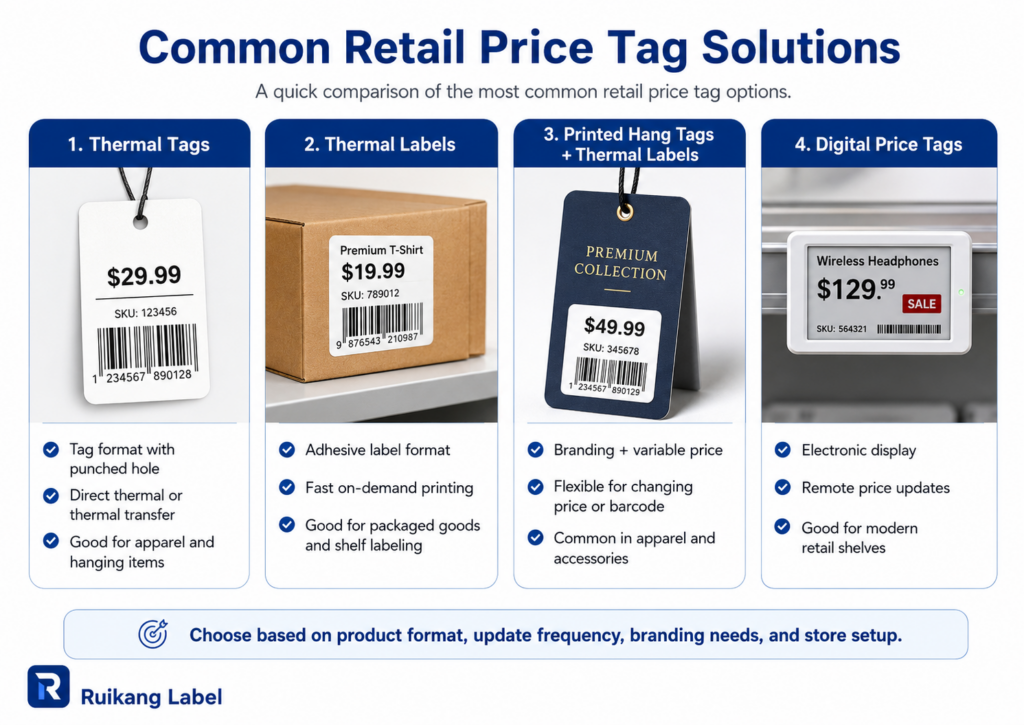
Some stores need a simple and low-cost way to print prices in-house. Some need better brand presentation. Some need both. In practice, price tags for retail store use usually fall into a few common solutions: thermal tags, thermal labels, printed hang tags paired with thermal labels, and digital price tags for retail.
The right option depends on how your products are displayed, how often prices change, whether you need barcodes, and how much you want the tag itself to support your brand presentation.
Thermal labels and thermal tags are often confusing. If you’re still not sure what thermal labels and thermal tags are, this article “What are Thermal labels and thermal tags ” may help.
Common Ways Retail Price Tags Are Used in Stores
Retail price tags are not always made the same way. Different stores use different tag formats depending on display style, information updates, and branding needs.
| Solution | Typical Format | Best Fit for Retail Use | Main Advantage | Main Limitation |
|---|---|---|---|---|
| Thermal Tags | Thermal hang tags | Apparel, footwear, accessories, gifts | Easy to print prices, SKUs, and barcodes on demand | Direct thermal media is less durable in heat, light, and abrasion |
| Thermal Labels | Thermal adhesive labels | Shelf labels, packaging, product surfaces, warehouse retail | Fast, flexible, and practical for frequent updates | Standard thermal labels usually offer less premium presentation |
| Printed Hang Tags + Thermal Labels | Premium printed tag plus thermal barcode label | Products that need both brand presentation and variable data | Separates visual branding from operational labeling | Requires two components instead of one |
| Digital Price Tags / ESL | Electronic shelf labels | Chain stores, high-frequency price changes, system-driven retail | Centralized price updates across stores or departments | Higher setup cost and greater system complexity |
Thermal Tags for Hanging Products
Thermal tags are commonly used for hanging products such as clothing, shoes, fashion accessories, and gift items. They are a practical option when stores need to print variable information such as price, SKU, or barcode at the store level.
This approach works well when information changes often and when the tag does not need to be stuck directly onto the product. For many retail shop price tags, especially in apparel and gift retail, thermal tags offer a good balance between flexibility and speed.
If you are using direct thermal media, keep the use environment in mind. Direct thermal materials are usually better suited to short- to medium-term use. If the tag needs to stay sharp for longer periods or will be exposed to heat, sunlight, or friction, you may need to evaluate other options.
Thermal Labels for Shelves, Packaging, and Product Surfaces
Thermal labels are one of the most practical choices for price tags for retail store use, especially when tags need to be applied to shelves, outer packaging, or directly onto products. They are widely used in convenience stores, grocery stores, discount stores, and warehouse-style retail.
If your team needs to update prices often, print barcodes in-house, or manage a large number of SKUs, thermal labels usually make the workflow simpler. They are easy to print, easy to replace, and easy to integrate into everyday retail operations.
For many retail shelf price tags, this is the most straightforward solution because it supports both price display and barcode-based store processes without adding unnecessary complexity.
Printed Hang Tags Paired with Thermal Labels
Some products need more than a basic label. In those cases, a two-part solution often works better: a high-quality printed hang tag for branding and presentation, plus a thermal adhesive label for price, barcode, SKU, or other variable information.
This setup is especially useful when the tag needs to do two different jobs. The printed hang tag supports the look of the product. The thermal label supports store operations. Instead of forcing one tag to handle everything, the visual function and the operational function are separated.
This approach works well for boutique retail, apparel, accessories, gifts, and products where presentation matters but price and barcode information still need to be updated in-house. For custom price tags retail projects, this combination can be a strong middle ground between aesthetics and flexibility.
Digital Price Tags for Retail
Digital price tags for retail, also called electronic shelf labels, are designed for stores that need frequent price changes and more centralized control. They are most common in larger retail environments where updates need to happen across multiple shelves, departments, or locations.
For stores with frequent promotions, dynamic pricing, or tighter system integration, digital price tags retail solutions may improve consistency and reduce manual relabeling. At the same time, they usually involve higher hardware costs, software integration, and ongoing maintenance.
That is why electronic retail price tags are not automatically the best choice for every store. For many retailers, thermal labels, thermal tags, or printed hang tags paired with thermal labels remain more practical and more cost-effective.
Which Retail Price Tag Solution Fits Your Store?
The right retail price tags depend on your store format, product type, and update frequency.
| Retail Setting | Better Fit | Why It Usually Works |
|---|---|---|
| Convenience stores, grocery, daily essentials | Thermal labels or shelf labels | Fast updates, barcode support, and practical day-to-day use |
| Apparel, footwear, boutique retail | Thermal tags or printed hang tags plus thermal labels | Better balance between presentation and variable information |
| Discount retail, warehouse retail, high-SKU environments | Thermal labels | Lower cost and easier high-volume management |
| Chain stores with frequent price changes | Digital price tags / ESL | Centralized updates and better pricing consistency |
| Premium or higher-ticket products | Printed hang tags plus thermal labels | Stronger presentation without giving up barcode and price flexibility |
Retail Shelf Price Tags vs Hanging Price Tags
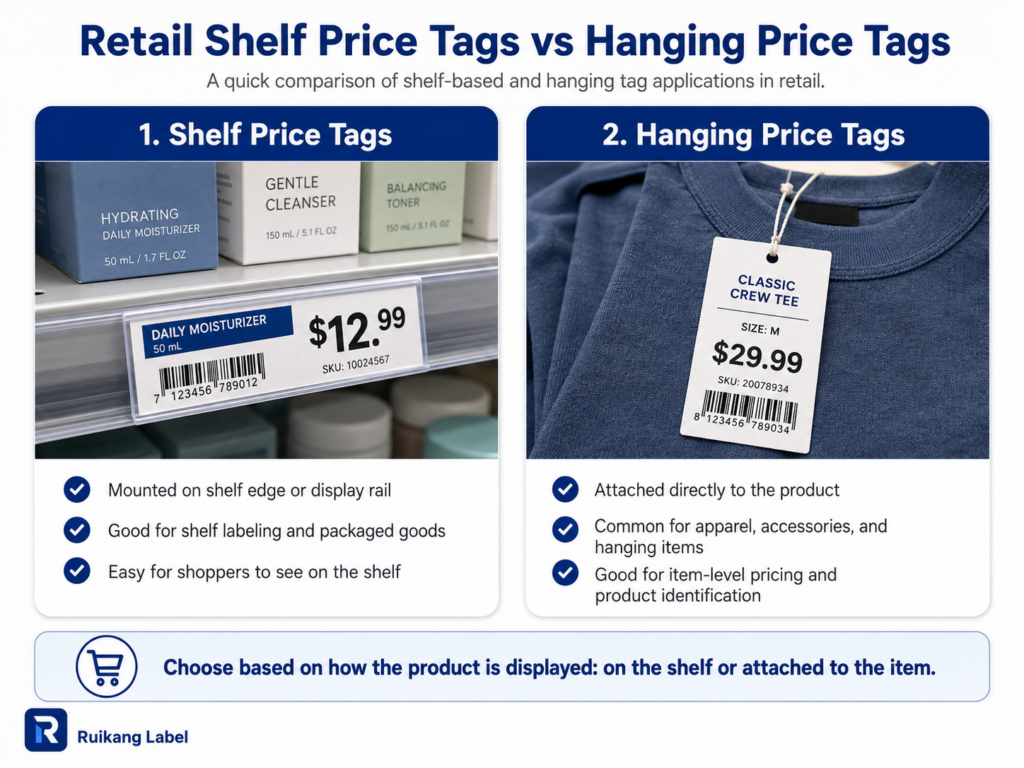
One of the first decisions to make is whether the tag should be attached to the shelf or attached to the product. That one choice often determines the rest of the tag strategy.
| Comparison Point | Retail Shelf Price Tags | Hanging Price Tags |
|---|---|---|
| Placement | Shelf edge, display area, packaging surface | Product body, string, hook, or fastener |
| Main Purpose | Price display, scanning, replenishment, shelf clarity | Product presentation, item identification, price display |
| Typical Update Method | Easier for batch replacement or in-store printing | Better for item-level display or combined tag solutions |
| Visual Priority | Moderate | Higher |
| Common Formats | Thermal labels, shelf inserts, ESL | Thermal tags, printed hang tags, dual-component solutions |
If your prices stay relatively stable and your layout rarely changes, printed retail price tags may be enough. If you print prices and barcodes on demand, thermal solutions are usually more flexible. If the product needs to look more premium but still needs a scannable barcode and changeable price, a printed hang tag plus a thermal label often makes the most sense. If your store changes prices constantly across many locations, digital price tags for retail may be worth evaluating.
When Pre-Printed Thermal Labels Make Sense
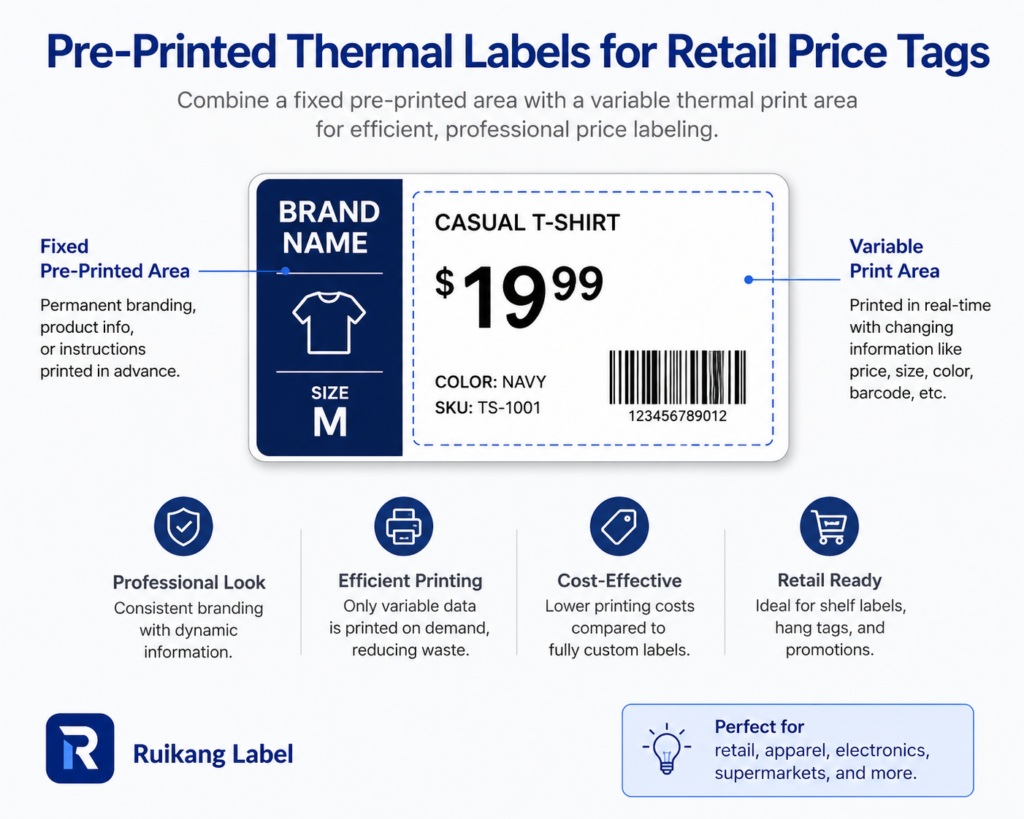
Pre-printed thermal labels work well when part of the label stays the same and part of the label needs to be printed later. For example, the fixed area may include a logo, category color, layout frame, or product line information. The variable area may include the price, SKU, barcode, batch number, or promotion details.
For retail price tags, this is useful when you want a more consistent look than a blank thermal label can provide, but you still need the flexibility of in-store printing. This is often a good fit for stores that use a standard label format across many SKUs but need to update the live data on demand.
If your goal is a single label with a fixed design plus variable data, pre-printed thermal labels are worth considering. If your goal is a premium branded tag plus a separate operational label, the printed hang tag plus thermal label approach is usually a better match.
If you still unsure what is pre-printed thermal labels, “When to Use Pre-Printed thermal labels” can help you figure it out.
Questions to Answer Before You Order Retail Price Tags
Before you order retail price tags, it helps to clarify a few things early. That makes the buying process faster and helps avoid mismatched materials, awkward layouts, or tags that do not fit your actual store workflow.
| Question to Ask | Why It Matters | What It Affects |
|---|---|---|
| Will the tag be applied to the product or attached as a hanging tag? | This determines whether labels or tags make more sense | Format, size, and structure |
| Which information stays fixed, and which information changes in-store? | This helps decide between printed, thermal, pre-printed, or two-part solutions | Cost, flexibility, and production method |
| Do you need barcode scanning at checkout or during inventory handling? | Barcode use changes layout priorities and print requirements | Scan reliability, barcode placement, and contrast |
| Do you already use a printer in-store? | Existing equipment affects compatibility and operating cost | Core size, roll size, print method, and media choice |
| Is visual presentation more important, or is update speed more important? | This helps balance branding against operational efficiency | Material choice, design approach, and workflow |
| Will the tag be exposed to heat, light, friction, or moisture? | Environmental conditions affect media performance | Durability, material selection, and print method |
If barcodes are part of the design, make scan reliability a priority from the start. In most retail environments, a black barcode on a white background is still the safest place to begin. It is easier to decorate around a reliable barcode than to fix scanning issues after production.
Conclusion
Retail price tags are not one-size-fits-all. The best solution depends on how your products are displayed, how often information changes, how important barcode handling is, and how much visual presentation matters in your store.
If you need speed and flexibility, thermal tags or thermal labels are often the strongest starting point. If you need brand presentation and variable data at the same time, printed hang tags paired with thermal labels can be a better fit. If you need a single label that combines fixed design with changeable information, pre-printed thermal labels are worth a closer look. And if your operation depends on frequent synchronized price changes, digital price tags for retail may be the right direction.